

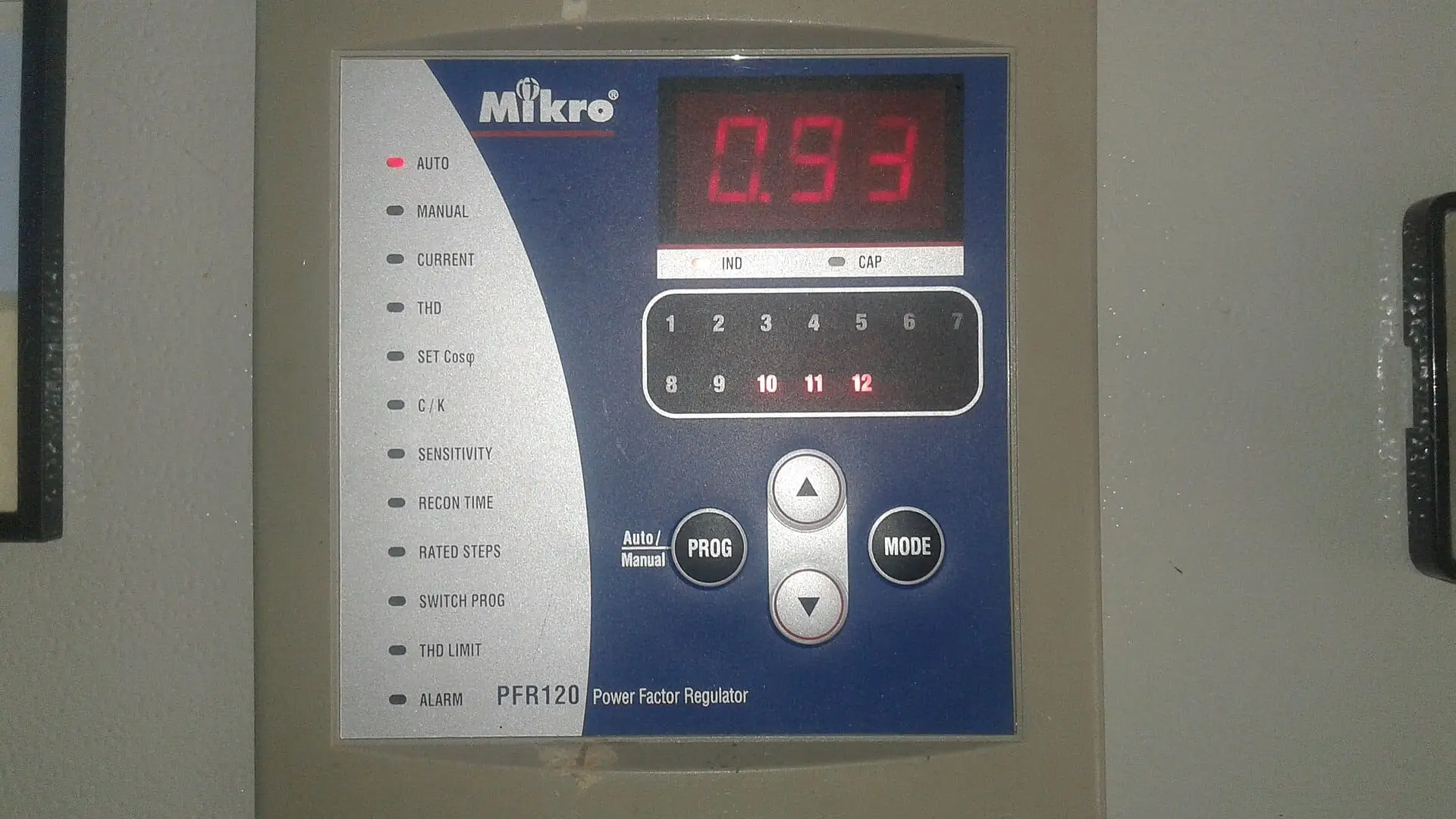
When assessing a facility’s electrical infrastructure, looking only at the active energy consumed may not be enough. The way motors and other loads operate also affects the facility’s reactive power exchange with the grid. Power factor correction helps manage this requirement with suitable equipment and control.
Having a correction panel does not mean the facility is correctly balanced under all operating conditions. An increase in production capacity, replaced machines or a different shift pattern may require reassessment.
Active, reactive and apparent power
Active power is expressed in kW, reactive power in kvar and apparent power in kVA. Power factor is the ratio P/S. Under sinusoidal conditions this ratio can be expressed as cosφ. With loads that contain harmonics, looking only at the phase angle may not be enough to explain the total power factor. Schneider Electric — Power factor (opens in a new tab)
This distinction also matters for communication within the facility. The statement “the facility’s power is 100” means nothing on its own. It should be stated whether this is an instantaneous kW value, a power value in the supply contract or the kVA on the transformer nameplate. Likewise, monthly kWh consumption and instantaneous kW demand should not be used interchangeably.
Simplified correction calculation
Assuming a sinusoidal, inductive load, the approximate capacitor power needed to bring the present cosφ to the target value is:
Qc = P × [tan(arccos(cosφ₁)) − tan(arccos(cosφ₂))]
When P is entered in kW, Qc is in kvar. This relationship comes from the power triangle; for actual panel selection, the load’s behaviour over time is also assessed. Schneider Electric — Theoretical principles of power factor improvement (opens in a new tab)
Purely as an example, consider a load with 80 kW active power, an initial cosφ of 0.80 and a target of 0.95. The calculation gives about 33.71 kvar. This is the theoretical requirement at the stated operating point. It does not mean that a fixed 33.71 kvar should be connected or that a particular standard panel should be chosen.
Why may a single measurement not be enough?
A facility may run at full capacity in the morning, at low load at lunchtime and with only a few auxiliary systems at night. These three states do not have the same reactive power requirement. For this reason, when preparing a project, it should be recorded when the measurement was taken and which loads were running at the time.
Useful information the facility can share includes consumption records, shift hours, the machine list, existing panel data and past interventions. In the technical and economic assessment, equipment, installation and maintenance costs are examined together with possible benefits. Schneider Electric — Determining the optimum level of compensation (opens in a new tab)
Which questions should be asked when the facility grows?
- Will the new machines run at the same time or in different shifts?
- Which steps of the existing correction system switch in?
- Have measurements also been taken during low-production hours?
- Have earlier changes been entered in the project and maintenance records?
The answers to these questions can be used to plan which measurements to take on site. Rather than simply adding parts before any symptom appears, the behaviour of the existing system should be assessed. Especially with local correction at a motor, the capacitor and switching arrangement are considered together with the motor’s characteristics. Schneider Electric — Power factor correction of induction motors (opens in a new tab)
Does power factor correction always deliver the same savings?
No fixed savings percentage can be stated for every facility. The present situation, operating hours, losses, measured values and applicable tariff conditions change the result. This article does not define a particular reactive energy charge or current tariff limit; the economic calculation should be made with the facility’s own data.
If your facility is growing, installing new machines or experiencing recurring electrical problems, you can contact us to have the existing infrastructure assessed.